
TRANSFORMING A FUEL
MARKETPLACE
I helped transform a transactional fuel ordering system into an operational decision-support platform, enabling gas station owners to manage supply risks and logistics more efficiently.
The challenge
Compliance teams in all industries face an overwhelming regulatory landscape: hundreds of frameworks, thousands of evolving obligations, and siloed documentation. Existing tools were fragmented, manual, and error-prone, leading to missed requirements, audit risks, and high operational costs. Our goal was to create a single source of truth. An intuitive solution that empowers users to:
• Rapidly subscribe to relevant regulations
• Track all obligations and changes in real time
• Streamline compliance workflows and reduce manual effort
The approach
Operational discovery
• I conducted exploratory interviews with franchise owners across different business profiles, from independent operators to large networks managing multiple stations.• I also interviewed internal stakeholders from commercial, logistics, and operations teams to understand the broader fuel supply ecosystem.
• Based on these conversations, I mapped operational workflows to understand how inventory monitoring, supply planning, and logistics decisions were handled in practice.
Mapping operational complexity
• Through research, I identified that fuel ordering was only one step within a broader operational journey.• I mapped the end-to-end journey including inventory monitoring, supply planning, order placement, logistics coordination, and financial management.
• This helped identify critical risk points where operational mistakes could lead to stockouts, delivery delays, or financial penalties.Insight-driven product strategy
• I discovered that many franchise owners relied heavily on manual forecasting and spreadsheets to plan fuel supply.• This insight helped shift the product perspective from a transactional tool to a platform that supports operational decision-making.
• I reframed CS Online as an operational hub for franchise management, integrating logistics, inventory visibility, and financial workflows.
Designing an operational marketplace
• I structured the product experience around the operational journey of franchise owners.• Based on the operational journey, I structured the experience around key decision moments for franchise owners.
• I also designed scheduling tools with compliance validation and operational alerts to reduce costly operational mistakes.
Mobile-first operational access
• I adopted a mobile-first approach to support operators managing stations directly on-site.• This allowed franchise owners to monitor inventory, place orders, and coordinate logistics directly from their smartphones.
• Prototyped core flows in Figma and ran usability tests with compliance teams.
Impact
The redesign helped shift CS Online from a transactional ordering interface into a platform that supports operational decision-making for franchise owners.
• Mobile adoption increased by 32%, enabling operators to monitor inventory and place orders directly from their smartphones, supporting faster real-time decisions in operational environments.
• Time required to place fuel orders decreased by 24%, improving operational efficiency and reducing the friction involved in supply planning.
• Self-service transactions increased by 18%, reducing reliance on manual support channels and empowering franchise owners to manage their operations more independently.
• Operational satisfaction scores improved by 15%, reflecting increased trust in the platform as a reliable tool for managing fuel supply and logistics.
Beyond these metrics, the project established the foundation for evolving CS Online into a broader marketplace ecosystem, enabling new services, supply integrations, and operational capabilities across the franchise network.
What I learned
Designing for operational environments requires focusing less on simplifying interfaces and more on supporting critical decision-making.
In these contexts, users are managing real-world constraints, logistics, timing, and financial risk, where clarity and reliability are more valuable than feature richness.
This project reinforced the importance of framing digital products as operational systems, not just transactional interfaces.
When designed around real workflows and decision points, digital platforms can directly improve how businesses operate day to day.
© Copyright 2024. All rights Reserved.
TRANSFORMING A FUEL MARKETPLACE
I helped transform a transactional fuel ordering system into an operational decision-support platform, enabling gas station owners to manage supply risks and logistics more efficiently.
The challenge
Fuel supply is a mission-critical operation for gas stations. Running out of fuel can lead to operational disruption, revenue loss, and penalties from the brand.
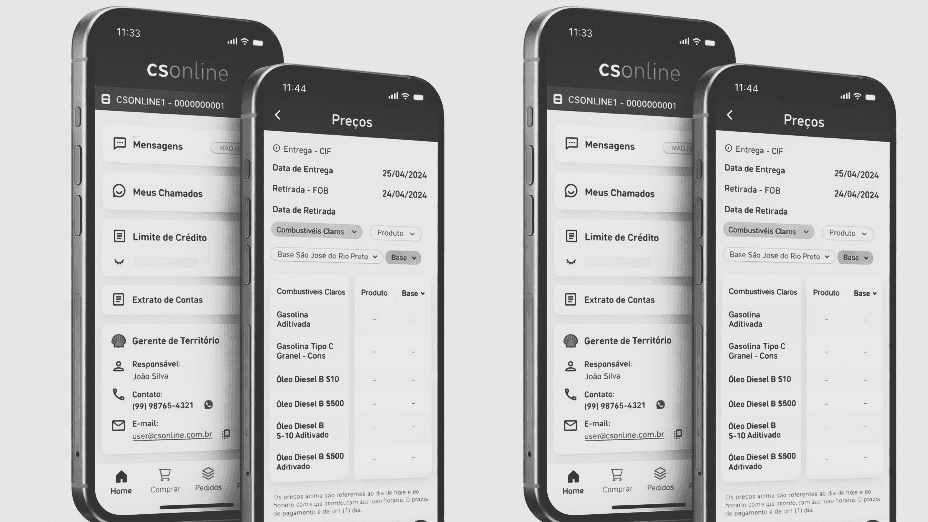
Shell franchise owners relied on a B2B platform called CS Online to order fuel, manage financial workflows, and coordinate logistics. However, the platform was primarily designed as a transactional ordering system, while operators actually depended on it to manage complex operational decisions.
My challenge was to help evolve the platform into a decision-support system that could support franchise owners in monitoring inventory, planning supply, and coordinating logistics more effectively.
The approach
Operational discovery
• I conducted exploratory interviews with franchise owners across different business profiles, from independent operators to large networks managing multiple stations.• I also interviewed internal stakeholders from commercial, logistics, and operations teams to understand the broader fuel supply ecosystem.
• Based on these conversations, I mapped operational workflows to understand how inventory monitoring, supply planning, and logistics decisions were handled in practice.
Mapping operational complexity
• Through research, I identified that fuel ordering was only one step within a broader operational journey.• I mapped the end-to-end journey including inventory monitoring, supply planning, order placement, logistics coordination, and financial management.
• This helped identify critical risk points where operational mistakes could lead to stockouts, delivery delays, or financial penalties.Insight-driven product strategy
• I discovered that many franchise owners relied heavily on manual forecasting and spreadsheets to plan fuel supply.• This insight helped shift the product perspective from a transactional tool to a platform that supports operational decision-making.
• I reframed CS Online as an operational hub for franchise management, integrating logistics, inventory visibility, and financial workflows.
Designing an operational marketplace
• I structured the product experience around the operational journey of franchise owners.• Based on the operational journey, I structured the experience around key decision moments for franchise owners.
• I also designed scheduling tools with compliance validation and operational alerts to reduce costly operational mistakes.
Mobile-first operational access
• I adopted a mobile-first approach to support operators managing stations directly on-site.• This allowed franchise owners to monitor inventory, place orders, and coordinate logistics directly from their smartphones.
• Prototyped core flows in Figma and ran usability tests with compliance teams.
Impact
The redesign helped shift CS Online from a transactional ordering interface into a platform that supports operational decision-making for franchise owners.
• Mobile adoption increased by 32%, enabling operators to monitor inventory and place orders directly from their smartphones, supporting faster real-time decisions in operational environments.
• Time required to place fuel orders decreased by 24%, improving operational efficiency and reducing the friction involved in supply planning.
• Self-service transactions increased by 18%, reducing reliance on manual support channels and empowering franchise owners to manage their operations more independently.
• Operational satisfaction scores improved by 15%, reflecting increased trust in the platform as a reliable tool for managing fuel supply and logistics.
Beyond these metrics, the project established the foundation for evolving CS Online into a broader marketplace ecosystem, enabling new services, supply integrations, and operational capabilities across the franchise network.
What I've learned
Designing for operational environments requires focusing less on simplifying interfaces and more on supporting critical decision-making.
In these contexts, users are managing real-world constraints, logistics, timing, and financial risk, where clarity and reliability are more valuable than feature richness.
This project reinforced the importance of framing digital products as operational systems, not just transactional interfaces.
When designed around real workflows and decision points, digital platforms can directly improve how businesses operate day to day.
© Copyright 2024. All rights Reserved.
© Copyright 2024. All rights Reserved.